
Cheap LED Ceiling Light Trap: Where Low-Quality Fixtures Cut Costs You Cannot See
A low quote on LED ceiling lights can hide cheaper drivers, lower-bin LEDs, thin heat sinks, recycled diffusers, skipped aging tests and weak certificates. Here is how importers can spot hidden cost cutting before a purchase order.
Two LED ceiling lights can look almost identical in a product photo: same wattage, same round diffuser, same white housing, same "2-year warranty" line in the quotation. One passes a project handover and keeps working quietly for years. The other starts flickering after six months, yellows at the diffuser, loses brightness, or fails the first incoming inspection. The cost difference is usually hidden inside the parts a buyer cannot see from the outside.
Low price is not automatically a problem. A mature source factory can quote competitively because it buys material at scale, runs its own production lines, and controls scrap. The real trap is a price that only works after the supplier removes material, skips tests, downgrades components, or pushes warranty risk back to the importer. This guide shows where low-quality LED ceiling lights usually cut costs and how to check those points before you issue a PO.
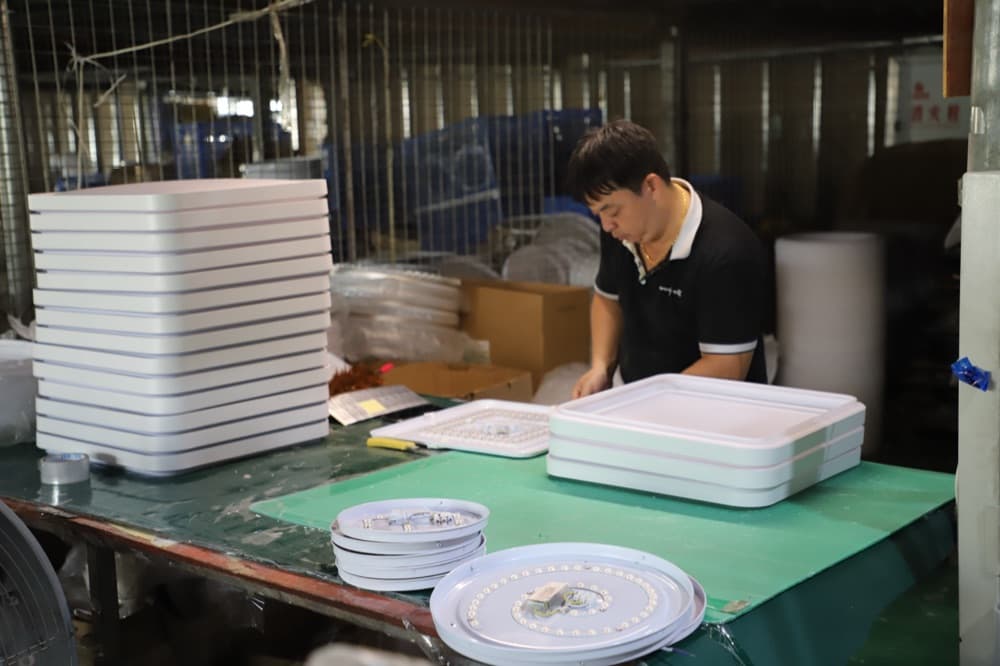
If you can review only one factory photo before asking deeper questions, make it a photo of the finished metal base plate before final assembly. It does not show every hidden component, but it anchors the discussion in a part buyers can actually inspect: thickness, flatness, hole accuracy, coating, edge finish and the surface that carries heat away from the LED board.
Why Cheap LED Ceiling Lights Hide Risk So Well
A ceiling light is a compact product. Most of the parts that determine lifetime are covered by the diffuser or hidden behind the back plate. A buyer can inspect color, size, packaging and basic lighting, but the real cost drivers are less visible:
- Driver topology, capacitor grade and protection design
- LED chip bin, luminous efficacy and thermal margin
- Aluminium PCB thickness, copper weight and heat transfer
- Metal back-plate thickness and surface treatment
- PC diffuser raw material and UV resistance
- Wiring, terminal blocks, screws and strain relief
- Aging-test duration, safety-test records and traceability
- Real certificate coverage for the exact model being shipped
If a supplier quotes 20-30% below the market median for the same specification, the saving usually comes from one or more of these areas. It rarely comes from "factory efficiency" alone.
1. Driver Cost Cutting: The Fastest Path to Failure
The driver is the most common hidden downgrade in cheap LED ceiling lights. It is also the part that creates the most painful after-sales problems because a failed driver means the whole fixture goes dark, flickers, buzzes or trips protection.
Common shortcuts include:
- Smaller electrolytic capacitors with lower temperature ratings
- Weak surge protection or no meaningful MOV / fuse design
- High output ripple that makes LEDs run hotter and flicker more
- Narrow input-voltage tolerance that struggles in unstable grids
- Undersized transformer, diode bridge or switching components
- No clear batch traceability from driver lot to finished fixture
A low-end driver may survive a 30-second power-on sample test. It may not survive four hours on an aging rack, a hot ceiling cavity, or repeated voltage spikes in the field. For importers, this is why "the sample lights up" is not a quality test.
Ask the supplier for driver brand or in-house model numbers, capacitor temperature rating, surge-test data, and the driver warranty policy. If the supplier only says "our driver is good quality" but cannot document the design standard, treat it as a warning sign.
2. LED Chips and Bin Codes: Bright at First, Weak Later
LED chips are another easy place to save money without changing the product photo. A cheaper LED chip or mixed-bin batch can still produce acceptable light on day one, especially in a showroom or sample video. The problem appears later as brightness decay, color inconsistency and uneven batches.
Hidden downgrades include:
- Lower-bin LEDs sold under the same wattage claim
- Mixed CCT bins that create visible color variation across one shipment
- Higher current driven through cheaper LEDs to hit a lumen target
- Weak phosphor stability that accelerates lumen depreciation
- No bin-code control at incoming inspection
For distributors and project buyers, this creates two business problems. First, replacement units may not match the first installed batch. Second, a product sold as a 30,000-hour fixture can lose useful brightness long before the warranty conversation starts.
On the RFQ, require the supplier to state LED brand or chip source, CCT tolerance, CRI target, luminous efficacy, and bin-control method. A serious factory can explain how it controls LED lots at IQC. A weak supplier usually only repeats "SMD 2835" or "high brightness LED."
3. Base Plate and Thermal Path: The Photo You Can Actually Use
Heat is the quiet killer of LED ceiling lights. If the LED board and metal base cannot move heat away from the chips and driver, the fixture may pass a short test but age quickly in real use.
Low-price models often cut cost through:
- Thinner aluminium PCB or lower copper weight
- Smaller metal back plate with less thermal mass
- Poor contact between LED board and base
- Less thermal paste or inconsistent application
- Plastic parts replacing metal where heat transfer matters
- Driver placed too close to high-temperature LED zones
The surface may still look clean. The product may even feel lighter and easier to install. But the thermal margin has been spent. Over time, high junction temperature accelerates lumen decay, color shift and driver stress.
This is where your factory base-plate photo fits the article. A good base-plate photo should show whether the plate looks flat, whether the screw holes and mounting points are clean, whether the coating is even, whether edges have burrs, and whether the LED board contact area looks stable enough for heat transfer. The photo does not replace a specification sheet, but it makes the hidden cost-cutting topic feel real instead of theoretical.
Ask for PCB thickness, copper weight, back-plate material thickness and thermal-test data. For a larger order, request a sample that can be opened before approval. If the supplier will not allow basic internal verification, do not treat the sample as fully approved.
4. PC Diffuser Downgrades: Yellowing, Glare and Lower Light Output
The diffuser is visible, but the material quality is not. A diffuser can look white in a sample photo and still be made from low-grade or recycled PC that yellows under heat and UV exposure.
Typical shortcuts:
- Recycled PC or mixed raw material instead of stable virgin PC
- Lower UV resistance for markets with strong sunlight or high temperature
- Lower transmittance, forcing higher LED current to compensate
- Poor haze control, creating glare spots or uneven light
- Brittle material that cracks during installation or shipping
This downgrade hurts both product appearance and optical performance. Buyers often discover it only after units have been installed in real rooms, where yellowing and uneven glow become obvious to the end user.
For ODM and OEM LED ceiling lights, ask for diffuser material grade, transmittance target, haze value, UV aging test method, and whether the factory controls diffuser lots at incoming inspection.
5. Wires, Terminals and Screws: Small Parts, Real Safety Risk
Small hardware looks like a minor line item until it fails. Cheap wires, weak terminals and soft screws do not usually show up in a product photo, but they affect installation safety, electrical reliability and customer complaints.
Cost-cutting signals include:
- Undersized wire gauge or weak insulation
- Loose terminal blocks that do not hold conductor pressure
- No strain relief on internal wiring
- Soft screws that strip during installation
- Thin mounting brackets that deform
- Poor labeling on live / neutral / ground connections
This is especially important for importers selling into retail, contractor or project channels. Installers notice weak hardware immediately. If the product feels cheap in the hand, the buyer's brand takes the damage even if the lamp initially works.
6. Aging Test Shortcuts: Saving Hours, Moving Failure to the Customer
Aging test is time, electricity, space and labor. That makes it one of the first places low-cost suppliers try to save money.
There is a big difference between:
- A 30-second functional power-on check
- A random sample aging test
- A real 100% full-load aging process with records
The first two options are cheaper. The third option catches early failures before shipment. Cheap LED ceiling lights that skip aging may pass factory packing, then fail in the first days or weeks after installation. For a distributor, that means replacements, technician visits, bad reviews and slow-moving inventory.
At Awta, every finished LED ceiling light runs through structured QC and aging stages before shipment. When you compare suppliers, ask for aging duration, pass-rate records and how failed units are isolated and analyzed.
7. Certificate Shortcuts: The PDF Does Not Always Cover Your Product
Certificates are another common low-price trap. A supplier may show a CE, RoHS, EMC, ETL or TUV document, but the document may not cover the exact model, wattage, driver, market version or production factory being quoted.
Watch for these problems:
- Certificate belongs to a different model family
- Test report uses a different driver or LED board
- Report is expired, incomplete or screenshot-only
- Supplier name on the certificate does not match the actual factory
- Claims like "CE available" without report number or issuing body
- One certificate used to cover too many unrelated SKUs
For customs, retail and project buyers, certificate mismatch can become a clearance problem or a liability problem. Request the full PDF report, verify the certificate number through the issuing body when possible, and match model numbers line by line against the quotation.
Awta's certificate library covers CE, CCC, ETL, TUV, RoHS and EMC, and full reports can be matched to the relevant product family before an order is confirmed.
8. Packaging Downgrades: The Hidden Cost After Container Loading
Packaging is easy to underestimate because it is not part of the fixture. But packaging determines whether the product reaches the buyer in sellable condition.
Cheap packaging shortcuts include:
- Thinner export cartons with low compression strength
- Weak inner protection around diffuser edges
- No drop-test validation
- Poor label adhesion or incorrect barcode placement
- Generic manual with wrong language or wiring diagram
- Pallet loading that crushes lower cartons
Packaging cost cutting turns into damaged diffusers, bent bases, missing accessories and warehouse rework. For e-commerce, retail and project delivery, packaging failure can be as damaging as electrical failure.
9. Warranty Shortcuts: A Low Quote with No Real Backup
Some cheap suppliers keep the quoted price low by making the warranty almost impossible to use. The product may say "2-year warranty," but the actual policy is vague:
- No written defect-rate threshold
- No replacement-first process
- No claim-response SLA
- No spare parts plan
- No batch traceability from carton to component lot
- Warranty only as discount on a future order
Before the first order, put the warranty policy into writing. Define covered failure rate, evidence requirements, response time, replacement method and whether the factory provides spare drivers or full replacement units. A supplier that cannot discuss warranty in detail usually does not price real warranty cost into the product.
Hidden Cost-Cutting Checklist for Buyers
Use this table when comparing LED ceiling light quotations. It helps separate a genuinely efficient factory from a supplier that has simply removed quality.
| Hidden Area | How Cost Is Cut | What It Causes | How to Verify Before PO |
|---|---|---|---|
| Driver | Cheaper capacitors, weak surge protection, high ripple | Flicker, early failure, buzzing, warranty claims | Component rating, surge data, aging records |
| LED chips | Lower bin, mixed CCT, overdriven LEDs | Brightness decay, color inconsistency | LED source, bin code, CCT tolerance, IQC records |
| PCB / base plate | Thin PCB, low copper, light base plate | Heat stress, lumen depreciation | Base-plate photo, PCB thickness, thermal test |
| PC diffuser | Recycled PC, low UV stability | Yellowing, glare, cracking | Material grade, transmittance, UV aging method |
| Wiring / terminals | Thin wire, loose terminals, weak screws | Safety risk, installer complaints | Open sample, wire gauge, terminal pull test |
| Aging test | Short power-on check instead of full aging | Early field failures | Aging duration, pass rate, failure analysis |
| Certification | Report for another model or incomplete PDF | Customs and compliance risk | Full report, model match, issuing-body verification |
| Packaging | Thin carton, weak inner protection | Damage, returns, warehouse rework | Carton spec, drop test, packing photos |
| Warranty | Vague replacement terms | Disputes after failures | Written SLA, defect-rate cap, traceability plan |
How Low Is Too Low?
A competitive quotation is normal. A quote far below the market needs investigation. As a practical rule, if one supplier is 20% lower than several comparable LED ceiling light manufacturers for the same wattage, material, certification and packaging, ask what changed.
Do not compare only the final FOB price. Compare the full specification:
- Real wattage and lumen output
- Driver specification and surge protection
- LED chip source and CRI / CCT tolerance
- Diffuser material and transmittance
- Metal base thickness
- Aging-test duration
- Certification coverage
- Packaging grade
- Warranty terms
If the cheaper quote wins on price but refuses to document these points, the risk has not disappeared. It has moved into your inventory, your warranty budget and your customer relationship.
What to Ask Before You Approve a Cheap LED Ceiling Light Supplier
Before sending a deposit, ask for evidence in this order:
- Full specification sheet with driver, LED, PCB, diffuser and packaging details
- One clear base-plate photo of the exact quoted model, supported by internal specifications
- Certificate PDFs matched to the quoted model number
- Aging-test process and recent pass-rate records
- Sample teardown approval before mass production
- Written warranty policy with claim response time
- Factory video or audit call covering QC stations
If you are still choosing a supplier, our guide on how to choose a reliable LED ceiling light manufacturer in China gives a broader factory-vetting checklist.
FAQ
Are all cheap LED ceiling lights bad?
No. A lower price can come from scale, stable material purchasing, efficient tooling or a simpler design. The risk starts when the supplier cannot explain how the same specification is much cheaper than the market. Price is not the problem; undocumented savings are the problem.
What can one base-plate photo actually prove?
It can prove only part of the story, but it is still useful. A base-plate photo can show material finish, hole accuracy, edge quality, coating consistency and the visible foundation of the thermal path. It cannot prove driver quality, LED bin control, aging-test discipline or certificate coverage. For serious orders, pair the photo with specifications and QC records.
What is the most important hidden component to check first?
Start with the driver. It has the highest impact on flicker, failure rate and safety. After that, check LED chip binning, thermal design and aging-test records.
Why do two suppliers quote different prices for the same wattage?
"Same wattage" does not mean same product. Driver design, LED efficacy, heat sink weight, diffuser material, safety testing, packaging and warranty policy can all change the real cost while the outside shape stays similar.
Should I always choose the higher-priced supplier?
No. Choose the supplier that can prove the specification. A higher price without evidence is also weak. The best supplier can explain the cost structure, show QC records and connect the price to measurable quality points.
Buy on Price, Approve on Evidence
LED ceiling light sourcing is not about avoiding low prices. It is about knowing where the supplier found the savings. If the savings come from scale, in-house production and stable QC, the quote can be a good opportunity. If the savings come from cheaper drivers, thinner heat sinks, skipped aging tests and vague certificates, the low price becomes the most expensive option in the shipment.
Awta builds OEM and ODM LED ceiling lights for importers, distributors and project buyers across Europe, North America, the Middle East and Southeast Asia. Our 15,000㎡+ source factory controls injection, blow molding, SMT, aging, assembly and packaging under one roof, with certification support and structured QC records available before order approval.
Ready to compare a quotation line by line? Send your RFQ with wattage, size, target market, certification requirement and estimated quantity. Our engineering team will help you identify which cost points are fixed, which are optional, and which should never be removed.
Related Articles
CE, RoHS, ETL and EMC for LED Ceiling Lights: What Buyers Need to Check
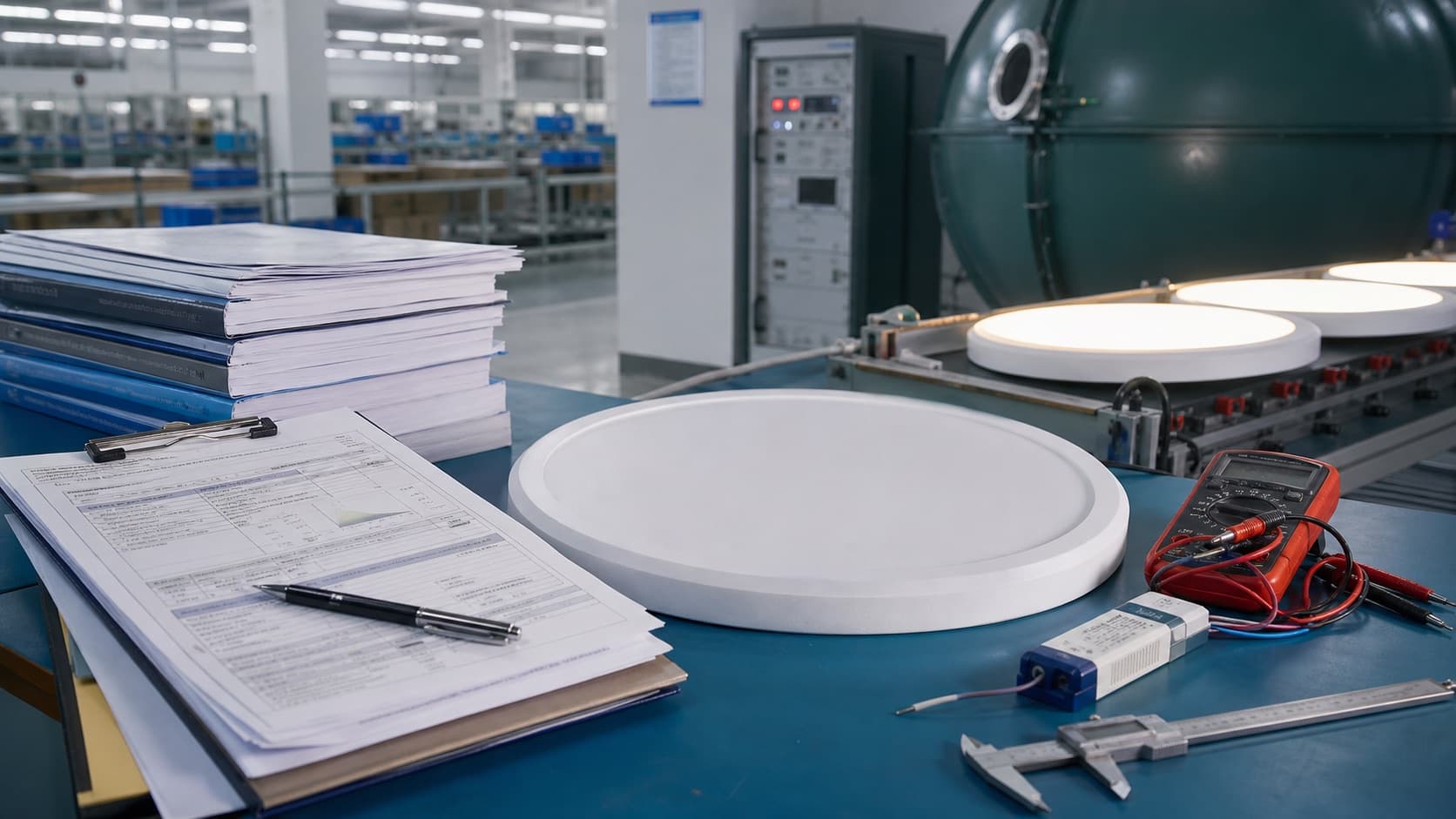
A logo on the box is not enough. Importers need to verify the directive, report, model family, applicant, product label and factory follow-up before they trust a ceiling-light certification pack.
Read More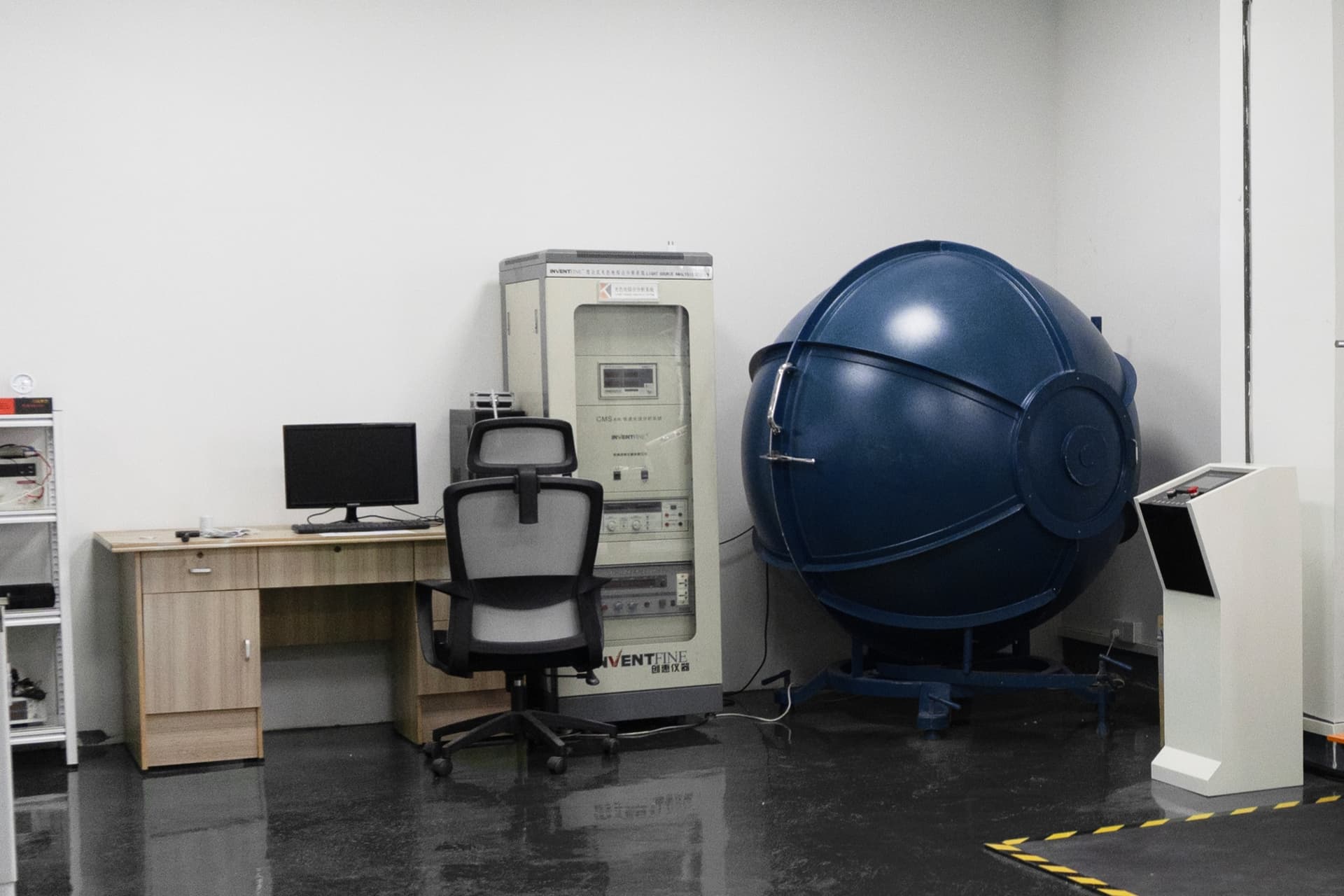
Inside Awta: The Quality Control Journey of an LED Ceiling Light
From the moment a reel of LED chips arrives at our gate to the final pre-shipment inspection, every Awta ceiling light passes through six structured QC stages. Here is what happens at each one — and what it means for the partners who put our product on their shelves.
Read More